

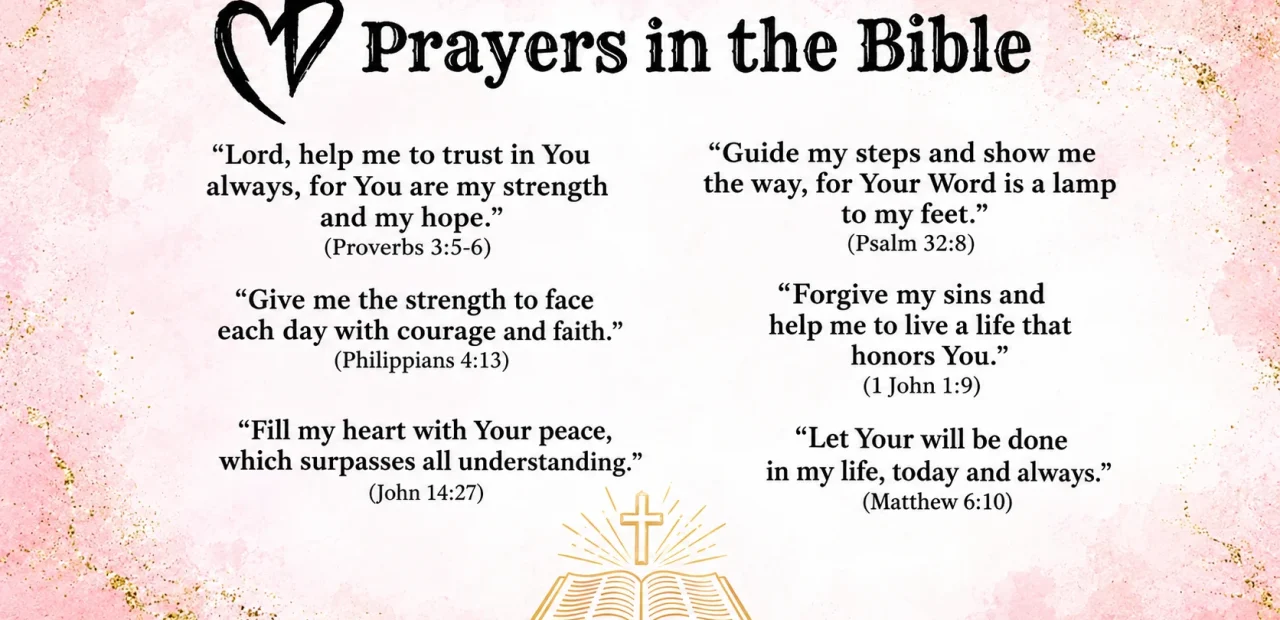
Prayers in the Bible get searched for a reason. Sometimes the words won’t come, and borrowing words that have already carried people through grief, fear, and gratitude feels safer than inventing something new.
What surprises many readers is how plain these prayers are. Not polished. Not poetic all the way through. Several are complaints. A few are barely a sentence long.
Scripture records people praying while afraid, while desperate, while thankful, and while completely out of options. That range is the point. There’s no single approved tone.
Some of the best-known Bible prayers came out of the worst moments of someone’s life. Others were said in quiet relief after something went right.
What follows walks through the main prayers in the Bible worth knowing, what each one was actually about, and how the same words still fit ordinary situations now.
Short enough to save. Honest enough to pray tonight.
The Lord’s Prayer
The clearest place to start is the prayer Jesus taught when asked directly how to pray.
Matthew 6:9-13 records it: “Our Father in heaven, hallowed be your name, your kingdom come, your will be done, on earth as it is in heaven. Give us today our daily bread. And forgive us our debts, as we also have forgiven our debtors. And lead us not into temptation, but deliver us from the evil one.”
Notice how short it is. Worship, daily needs, forgiveness, protection. Four things, no padding.
It’s used across Christian prayer traditions, in Catholic prayers and Protestant worship alike, which is part of why it’s the most recognised prayer in the world.
Praying it slowly, one line at a time, tends to work better than rushing through from memory.
Prayers of Desperation
Hannah’s Prayer
1 Samuel 1 describes Hannah praying silently in the temple, so distressed that Eli assumed she was drunk. She was praying for a child after years without one.
Her later prayer of thanksgiving in 1 Samuel 2:1-10 is one of the most joyful passages in the Old Testament.
That pairing matters. Grief and gratitude from the same person, recorded side by side.
Jonah in the Fish
Jonah 2 contains a prayer prayed from about the lowest possible place. Jonah 2:2 says, “In my distress I called to the Lord, and he answered me.”
Useful for anyone praying from a situation they largely created themselves.
The Tax Collector
Luke 18:13 records seven words: “God, have mercy on me, a sinner.”
Short prayers rarely get shorter. Jesus said this man went home justified, unlike the more impressive prayer said nearby.
Prayers for Protection and Deliverance
Some of the most read prayers in the Bible are about safety.
Psalm 23 is the one most people know. “The Lord is my shepherd, I lack nothing” opens it, and verse 4 carries the line about walking through the darkest valley without fear.
A Psalm 91 prayer is turned to constantly by people asking for God’s protection over family, home, and travel. The imagery is shelter, refuge, and wings.
Psalm 121:7-8 promises, “The Lord will keep you from all harm; he will watch over your life; the Lord will watch over your coming and going both now and forevermore.”
A short prayer drawn from these:
“Lord, be the shelter over this family tonight. Watch the coming and going of everyone under this roof. Amen.”
Prayers for Wisdom and Guidance
Solomon’s request in 1 Kings 3:9 stands out because of what he didn’t ask for. Not wealth, not long life. A discerning heart to govern well.
James 1:5 follows the same thread, saying that anyone lacking wisdom should ask God, who gives generously without finding fault.
That’s the prayer for guidance most people actually need before a decision. Not a sign. Just clearer thinking.
Short version:
“Father, give a discerning heart today. Enough wisdom for the next decision, not the whole road. Amen.”
Prayers of Honest Struggle
This is the category most readers don’t expect to find in Scripture.
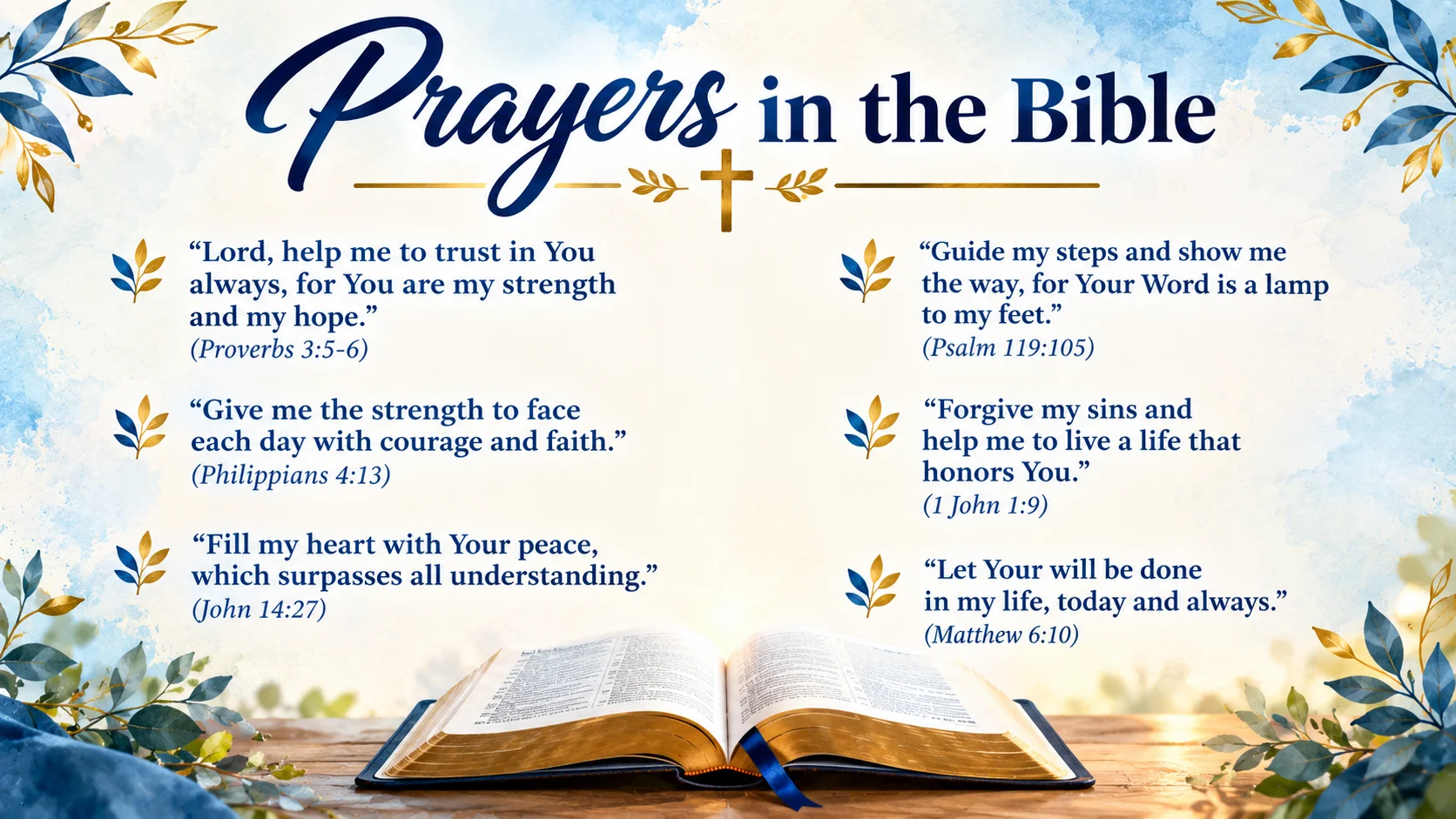
Habakkuk opens his book asking God how long he has to call for help before anything happens. Psalm 13 begins, “How long, Lord? Will you forget me forever?”
Jesus himself quoted Psalm 22 from the cross, according to Matthew 27:46: “My God, my God, why have you forsaken me?”
Complaint has a place in Christian prayer. Scripture never treats honesty as disrespect.
For anyone praying through a long illness, a grief that hasn’t lifted, or a prayer that hasn’t been answered, these passages give permission to say so plainly.
Gethsemane
Matthew 26:39 records Jesus praying, “My Father, if it is possible, may this cup be taken from me. Yet not as I will, but as you will.”
Both halves matter. Ask for the outcome wanted. Then hand it over.
Few prayers in the Bible sit closer to how real fear feels.
Prayers of Repentance and Fresh Starts
Psalm 51 is David’s prayer after being confronted about Bathsheba and Uriah. Verse 10 reads, “Create in me a pure heart, O God, and renew a steadfast spirit within me.”
No excuses in it. That’s what makes it usable.
Luke 23:42 records the thief on the cross asking simply, “Jesus, remember me when you come into your kingdom.” A last-minute prayer, and it was enough.
Short prayer for a hard day’s end:
“Lord, forgive what today got wrong. Let tomorrow start clean. Amen.”
Paul’s Prayers for Other People
Paul’s letters contain some of the most quoted intercessory prayers in Scripture.
Ephesians 3:16-19 asks that readers be strengthened with power through God’s Spirit and grasp how wide and long and high and deep Christ’s love is.
Philippians 4:6-7 gives the instruction most often reached for during anxiety: bring everything to God with thanksgiving, and God’s peace, which transcends understanding, will guard hearts and minds.
Colossians 1:9-12 prays for wisdom, endurance, and patience for people the writer had never even met.
Praying for someone by name using Paul’s words is one of the simplest ways to use prayers in the Bible in daily life.
How to Use Bible Prayers Day to Day
Reading a prayer and praying it aren’t the same thing. A few practical ways people bridge that gap:
Pray a psalm slowly. One verse at a time, pausing where something lands.
Swap in real names. Psalm 121 prayed over a specific child travelling somewhere hits differently than read in general.
Keep one short line ready. Luke 18:13 or Psalm 51:10 are short enough to remember in a waiting room.
Use them as a starting point. Begin with Scripture, then keep talking in ordinary words.
Bible verses about prayer are less about technique than about honesty. 1 Thessalonians 5:16-18 encourages rejoicing always, praying continually, and giving thanks in all circumstances.
Final Verdict
The prayers in the Bible are shorter, rougher, and more human than most people expect. Desperate ones. Grateful ones. A few that sound like arguments.
Pick three to keep close. Psalm 23 for fear, Psalm 51:10 for a bad day, Philippians 4:6-7 for worry that won’t settle.
Read one slowly before praying in ordinary words. Scripture gives the opening line; the rest can be plain and personal.
And send one to someone struggling this week. Ancient words, arriving at exactly the right moment, often say what a long message can’t.




3 responses